
A garage door that feels heavier than usual is not just inconvenient when you are heading to work. It can be a warning that the springs are no longer carrying their share of the weight. A quick garage door balance test can help you spot the problem before the opener strains, a cable slips, or the door stops halfway with your vehicle trapped inside.
This is one of the few basic checks a homeowner can perform without tools, provided the door is in good condition and you do not touch the springs, cables, or brackets. Those parts are under serious tension. Your job is simply to see how the door behaves. If it fails the test, leave the adjustment to a garage door technician.
What a garage door balance test tells you
Your garage door opener is designed to guide the door, not lift its full weight. Torsion springs above the door, or extension springs along the tracks, do the heavy lifting. When those springs are correctly tensioned and in good condition, a manually operated door should feel surprisingly light and stay where you place it.
A balanced door usually moves smoothly, does not race upward or crash down, and can sit open around the halfway point without drifting much. A door that drops, shoots up, or feels extremely heavy is out of balance. That does not automatically mean a spring has broken, but it does mean the system needs attention.
In Southern Ontario, winter wear can make problems show up faster. Cold temperatures can stiffen rollers, dry out moving parts, and expose a spring that was already losing strength. Ice around the bottom seal can also make the opener work harder. A balance check helps separate a door problem from an opener problem.
How to do a garage door balance test safely
Choose a dry day, make sure children and pets are clear of the garage, and do not test a door with an obvious broken spring, loose cable, bent track, or crooked panel. If the door is hanging unevenly or you heard a loud bang, stop there and arrange a repair.
1. Close the door fully
Start with the garage door closed. Look at the cables on both sides from a safe distance. They should be sitting properly on their drums or pulleys, not loose, frayed, or wrapped unevenly. Also look for a visible gap in the torsion spring above the door, which often indicates a broken spring.
If anything looks out of place, do not run the opener again. A door with a failed cable or spring can move unpredictably.
2. Disconnect the opener
With the door closed, pull the red emergency release cord to disconnect the door from the opener trolley. If your garage has no side access door, plan this carefully. Once disconnected, you may not be able to open a very heavy door safely on your own.
Never pull the emergency release while the door is open. If the spring system has failed, the door may come down quickly.
3. Lift the door by hand
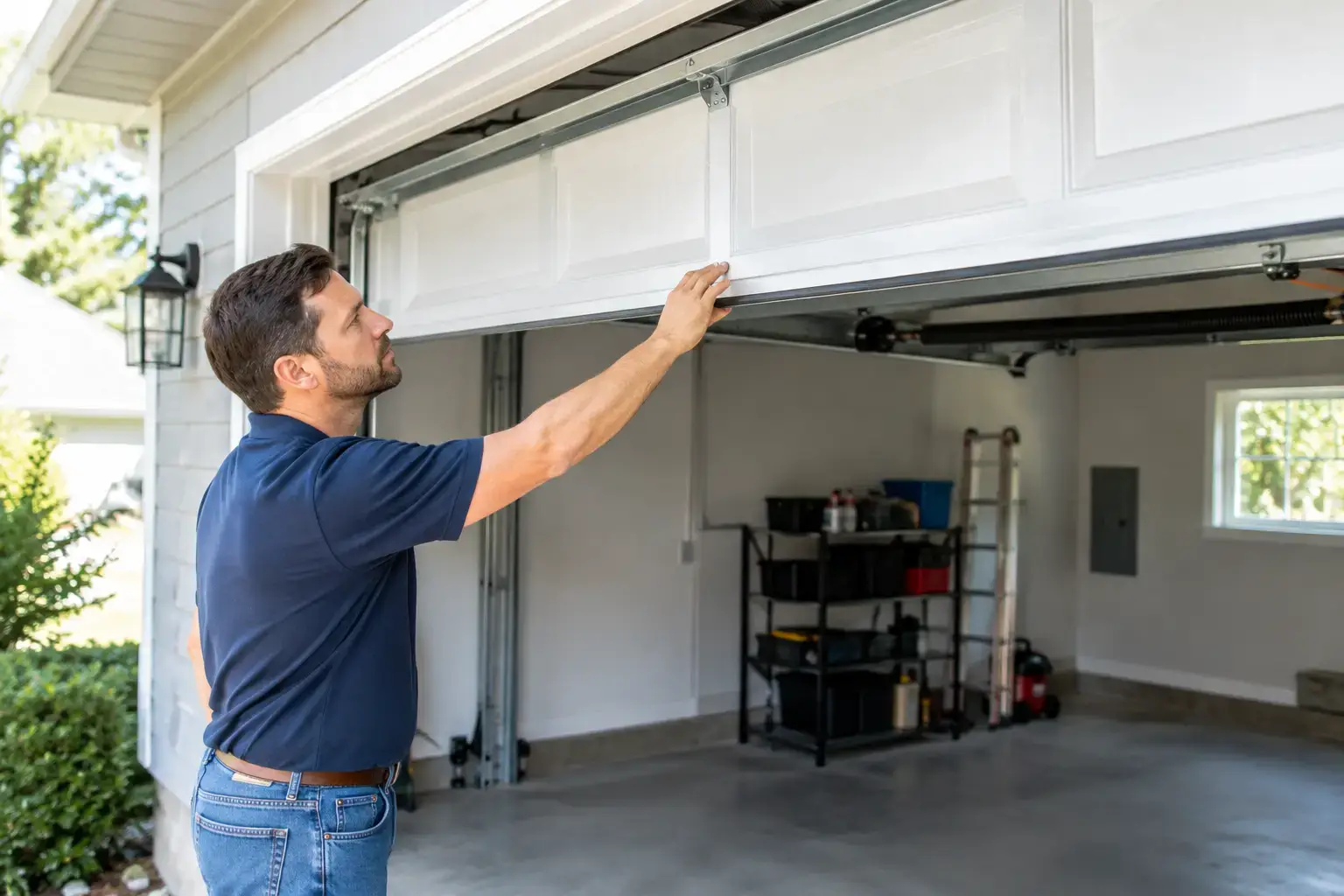
Grip the door from a safe, centred position and lift it slowly. A properly balanced residential door should move with moderate effort. It should not feel like you are lifting the entire weight of a car hood, and it should not bind, scrape, or jerk along the tracks.
Raise it to about waist or chest height, then carefully let go while keeping your hands clear of pinch points. The door should stay roughly in place. A small amount of movement is not unusual, but a rapid drop or a strong rise is a clear sign that the spring tension is wrong or the system has another mechanical issue.
4. Check a few positions
Lower the door gently, then repeat the check at about halfway open and near the fully open position. A good door stays controlled through its full travel. If it is easy to lift from the floor but pulls hard in the upper half, or if it becomes heavier at one side, there may be more than a simple balance issue.
Do not force the door all the way open if it feels rough or unstable. Stop and close it if you can do so safely.
5. Reconnect the opener only if the door is stable
Once the test is done, close the door completely by hand and reconnect the opener. Run one normal open-and-close cycle while watching from a safe distance. Listen for straining, grinding, popping, or repeated clicking. The opener should not need to fight the door to move it.
Signs your garage door is out of balance
The halfway test is useful, but daily use often gives you the first clues. Watch for a door that starts closing then reverses, opens only a few inches, slams shut, or stops in different spots from one day to the next. You may also notice the opener motor humming longer than normal or the chain, belt, or rail moving roughly.
A noisy door is not always unbalanced. Worn rollers, dry hinges, loose hardware, and damaged tracks can all create noise. But when noise comes with a heavy feel, uneven movement, or an opener that struggles, a spring and balance inspection should be the first step.
A door that hangs crooked deserves urgent attention. Usually, that points to a cable issue, a seized roller, a track problem, or damage caused by the door operating with a weak spring. Do not try to straighten it by hand or pull it closed with the opener. That can turn a repairable problem into a damaged door section or bent track.
What not to do after a failed balance test
Do not tighten or loosen the spring yourself. Torsion springs store enough force to cause serious injury if a winding bar slips or a fitting fails. Extension springs also require proper containment and adjustment. Online videos can make the work look simple, but they do not account for the exact door weight, spring size, track setup, and condition of the hardware in your garage.
Avoid compensating by increasing the opener force setting. This may make the door move temporarily, but it does not fix the cause. It can also reduce the opener's ability to reverse when it meets an obstruction, which creates a safety concern for people, pets, and property.
Do not keep cycling a door that is clearly heavy. An opener can strip gears, overheat, damage its rail, or pull on a weakened cable. The sooner the mechanical issue is corrected, the better the chance of avoiding a larger repair.
When a balance issue needs same-day service
Some balance problems can wait until a convenient appointment, such as a door that is slightly noisy but still travels smoothly and stays in position. Others should be treated as a same-day repair. Call for help if the door will not open, will not close securely, is stuck partway, has a broken spring, has a cable off its drum, or is visibly crooked.
If your vehicle is trapped inside or the garage cannot be secured overnight, there is no reason to wait. Tell the technician exactly what the door is doing: whether you heard a bang, whether the opener runs, where the door stops, and whether one side is lower than the other. Those details make it easier to give a straightforward quote and arrive prepared.
Summit Garage Door handles balance-related spring, cable, roller, track, and opener problems across Cambridge and surrounding Southern Ontario communities, with no added charge for emergency, evening, or weekend calls. The goal is simple: identify the failed part, explain the repair clearly, and get the door moving safely again.
A garage door balance test takes only a few minutes, but it can save an opener from unnecessary damage and give you an early warning before access to your home becomes a problem. If the door does not feel controlled in your hands, trust that signal and leave the spring work alone.