
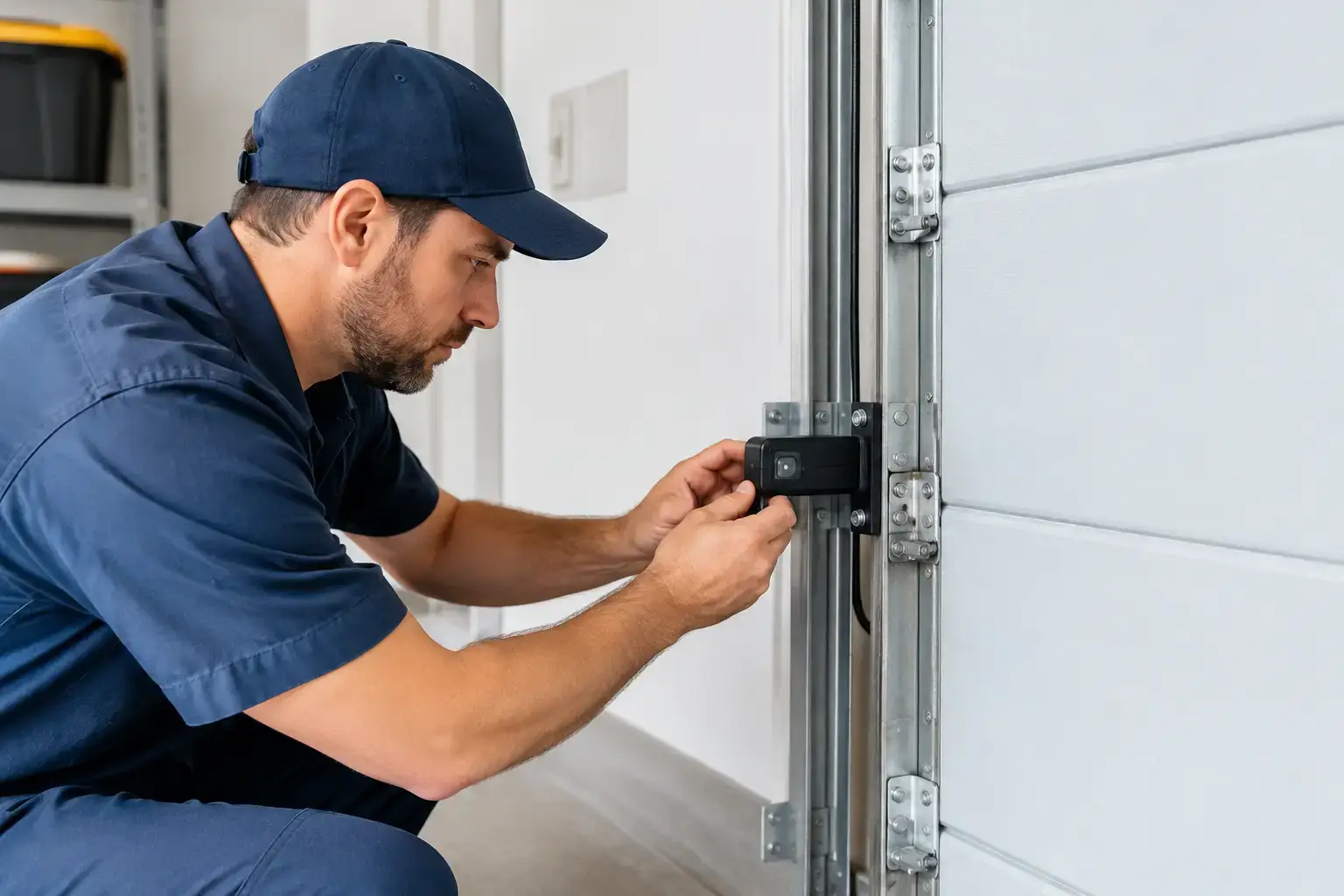
A garage door that starts down, then immediately reverses can leave your vehicle trapped and your home unsecured. Garage sensor alignment is often the reason, especially when the opener lights flash or the door will only close while you hold the wall button. The good news is that the photo-eye sensors are usually easy to inspect. The important part is knowing when a simple adjustment is enough and when the problem points to wiring, the opener, or the door itself.
What garage door safety sensors actually do
Most modern residential garage doors have two small safety sensors mounted near the floor, one on each side of the opening. They send an invisible beam across the doorway. If that beam is blocked while the door is closing, the opener stops and reverses the door.
This safety feature prevents the door from closing on a person, pet, bicycle, garbage bin, or vehicle. It is not optional equipment to work around. If the sensors cannot see each other clearly, the opener treats it like an obstruction and will not allow a normal closing cycle.
A sensor issue usually affects closing only. If your door will not open, hangs crooked, makes a loud bang, or feels extremely heavy, sensor alignment is probably not the main problem. Those symptoms can point to a broken spring, cable, roller, track, or opener issue that needs a different repair.
Signs your sensors are out of alignment
The most common sign is a door that closes partway and then goes back up. You may also find that the door will close only when you hold the wall control button down continuously. That manual hold function is designed to let you close the door carefully when the safety circuit is not reading properly.
Look at the small indicator lights on both sensors. Their colour and behaviour vary by manufacturer, so do not rely on one universal colour chart. What matters is that each sensor should have a steady light when it has power and a clear line of sight to the other side. A blinking or unlit indicator often means the beam is blocked, the sensor has moved, or there is a wiring problem.
Garage sensor alignment problems are especially common after a bump from a snow shovel, recycling bin, bike tire, child’s toy, or vehicle. In Southern Ontario, spring melt, road salt, moisture, and winter debris can also build up around the bottom of the garage opening. Even a small shift in a sensor bracket can break the beam.
Check the simple causes first
Before adjusting anything, make sure there is no actual obstruction in the opening. Sweep away leaves, snow, gravel, spiderwebs, and anything sitting between the sensors. Check that the bottom of the door and the tracks are clear as well.
Next, gently wipe both sensor lenses with a soft, clean cloth. Do not use abrasive cleaners or force the lens. Dust, condensation, and grime can interfere with the beam just as easily as a physical object.
Then inspect each sensor bracket. The sensors should face directly across the opening at roughly the same height. If one is tilted toward the floor, ceiling, or outside wall, loosen the bracket slightly, point it toward the other sensor, and tighten it again. Small adjustments are usually all that is needed.
Avoid bending brackets aggressively. A bracket that keeps moving, is rusted through, or has been hit hard may need replacement. Forcing it into place can damage the sensor or leave it misaligned again the next day.
A safe way to line them up
Start with the sensor that has the steady indicator light, if one does. Slowly adjust the sensor with the blinking or unlit light until its indicator becomes steady. Keep the sensor at its original mounting height where possible, then tighten the wing nut or fastener without twisting the unit.
Once both lights are steady, stand clear of the doorway and test the door using the normal wall button or remote. Watch a full closing cycle. Then test the safety system properly by placing a solid object, such as a piece of lumber, flat on the floor in the path of the closing door. The door should reverse when it contacts the object. Do not use a child, pet, foot, or your hand for this test.
If the door closes normally after that, keep an eye on it for a few days. A sensor that drifts out of position again may have a loose bracket, a damaged mounting point, or a cable problem.
When alignment is not the real issue
Not every reversing door has a sensor problem. A garage door can also reverse because it is binding in the tracks, catching on a damaged roller, or encountering too much resistance. The opener senses that force and reacts as though it has hit an obstruction.
Watch the door from a safe distance as it moves. If it shakes, scrapes, jerks, or slows noticeably in one spot, stop using it. A bent track, worn roller, loose hinge, or damaged panel can make the opener work too hard. Repeatedly running a binding door can turn a smaller repair into a failed opener or an off-track door.
The sensor wiring also deserves a quick visual check. Look for loose staples, pinched low-voltage wires, chewed insulation, or wires pulled from the sensor terminals. Do not attempt to repair damaged wiring with tape where it runs near moving parts or exposed outdoor areas. A technician can trace the circuit and replace the damaged section safely.
Direct sunlight can cause an occasional issue as well. If the door refuses to close at the same time every afternoon but works later, sunlight may be overwhelming one sensor. A proper sensor sun shield or a professional mounting adjustment can help. Moving the sensors randomly is not always the answer because they still need to remain correctly positioned and protected near the floor.
Do not bypass the safety sensors
Holding the wall button until the door reaches the floor may be useful as a short-term measure when you need to secure the garage, but it is not a repair. Do not tape the sensors together, disconnect them, alter the wiring, or bypass the safety system. That creates a real injury and property-damage risk.
It is also worth being careful around the door while troubleshooting. Stay out from under a door that is moving unpredictably, and never touch springs, lift cables, drums, or bottom brackets. Those parts are under high tension. A sensor problem may be simple, but a door that is crooked or has a slack cable is not a do-it-yourself adjustment.
When to call for garage sensor repair
Call for service when both sensors appear clean and properly aimed but their lights will not stay steady, when wiring is visibly damaged, or when the door still reverses after alignment. It is also time for a professional inspection if the door is noisy, uneven, off its tracks, or only closes with constant pressure on the wall button.
A technician can check sensor alignment, brackets, wiring, opener settings, track condition, rollers, and the door balance in one visit. That matters because a door may show one obvious symptom while the root cause is mechanical wear elsewhere in the system.
At Summit Garage Door, the approach is straightforward: tell us what the door is doing, including whether it reverses, flashes lights, closes only with the wall button, or makes noise. You can get a straight quote before dispatch, and an experienced local crew can determine whether the fix is sensor alignment, wiring repair, or something more serious.
A garage door should close smoothly without guesswork. If a careful cleaning and adjustment do not restore that normal operation, leave the safety system in place and have the whole door checked before the next cold, wet, or busy morning catches you with a garage that will not close.